Space

Interstellar Comet 3I/ATLAS Headed Towards Jupiter

Interstellar Comet 3I/ATLAS Headed Towards Jupiter The interstellar comet 3I/ATLAS recently passed by Earth on December 19, debunking any speculation about an alien landing on our planet. The comet is now continuing its journey through the Solar System, with Jupiter as its upcoming destination. Despite rumors circulating about an alien spaceship, a new article sheds light on the comet 3I/ATLAS, detailing its composition, characteristics, and ongoing studies to unravel its mysteries. The article also addresses the unfounded claims and speculations surrounding the interstellar object.


Stable Monitoring of Solar Wind to Resume in Spring 2026

Stable Monitoring of Solar Wind to Resume in Spring 2026 Observers have noted frequent interruptions in telemetry data, leading to challenges in monitoring space weather. Recent records show a daily loss of up to 50% of vital information. In the United States, efforts are concentrated on the SWFO-L1 spacecraft, which boasts advanced tools for studying solar wind, including a coronagraph. The spacecraft is expected to reach the Lagrange point in January 2026.


All Living Beings Carry Stardust

All Living Beings Carry Stardust We are all made of atoms from long-dead stars. This poetic notion highlights the scientific fact that the elements composing our bodies were forged in the cores of ancient stars. Every living being on Earth, from humans to plants, carries stardust within them. This concept connects us to the vast universe, reminding us that we are part of something much larger and older than ourselves. It inspires awe and wonder, emphasizing the interconnectedness of all life and the cyclical nature of existence.


Belka and Strelka: Pioneering Space Travelers

Belka and Strelka: Pioneering Space Travelers Belka and Strelka made history as the first living beings to return safely from space. The two dogs became pioneers in space travel, demonstrating that living creatures could endure and survive the conditions of space travel. Their successful mission marked a significant milestone in the exploration of outer space. These brave canine astronauts paved the way for future space travel experiments involving living organisms. Belka and Strelka's safe return provided valuable insights into the effects of space travel on living beings and contributed to the advancement of space exploration technology. Their historic journey continues to inspire and captivate people around the world.


NASA Pauses Rescue Attempts for Mars Probe MAVEN

NASA Pauses Rescue Attempts for Mars Probe MAVEN The NASA spacecraft MAVEN, dedicated to researching the Martian atmosphere and ionosphere for a decade, ceased signal transmission to Earth in early December. Search operations for MAVEN will be on hold for 2.5 weeks due to a solar conjunction, disrupting data communication between Mars and Earth.


Salyut-4: Second Generation Scientific Laboratory

Salyut-4: Second Generation Scientific Laboratory "Salyut-4" marked a significant milestone as the first domestic station where two crews successfully worked. Launched on December 26, 1974, its mission included the historic docking of "Soyuz-19" and "Apollo," which further enhanced its importance in space exploration history. The Long-Term Orbital Stations project saw notable progress with the development of "Salyut-4." Setting it apart from its predecessors, this station demonstrated advancements in space technology and capabilities, paving the way for further innovations in scientific research and international cooperation in space missions.


Einstein Predicted Gravitational Lens Effect

Einstein Predicted Gravitational Lens Effect Albert Einstein predicted the gravitational lens effect in 1915 as part of his general theory of relativity. He calculated the angle of deviation of a light ray in a gravitational field with precision. By the late 20th century, scientists had discovered dozens of gravitational lenses. Some of these images form a ring shape, either smooth or interrupted, commonly referred to as the "Einstein ring" or "Chwolson-Einstein ring."


Russia Develops Robot for Space Optics Quality Control

Russia Develops Robot for Space Optics Quality Control The "Angstrom" complex, featuring two manipulators, is designed to detect defects like scratches, film contamination, dirt, or molecular deposition on optical components in space technology. One manipulator directs a laser beam onto the surface, while the other captures the reflected radiation. The device is fully operational and poised for mass production.


Number of Days with Magnetic Storms in 2025 Reaches Record High

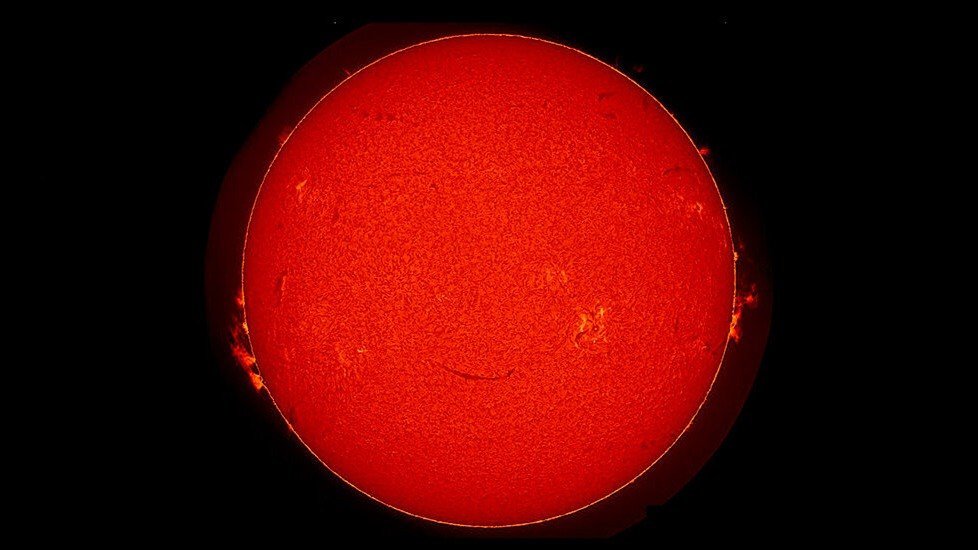
Number of Days with Magnetic Storms in 2025 Reaches Record High Since the beginning of the year, scientists have recorded 69 cases of magnetic storms, a significant increase from the 44 cases in 2024. Moreover, the number of days with geomagnetic disturbances has peaked at a 20-year high. This surge in activity is attributed to an unusually high number of coronal holes on the Sun.


Scientists Continue the Search for Alien Traces

Scientists Continue the Search for Alien Traces The head of the Society for the Study of UAP in the US, Michael Chifone, clarified that while aliens have not been found, the research efforts will persist. The primary obstacle remains the insufficiency and inadequacy of data. To address this, society members propose implementing a nationwide observational system comprising numerous high-resolution cameras and sensors.