Analytics

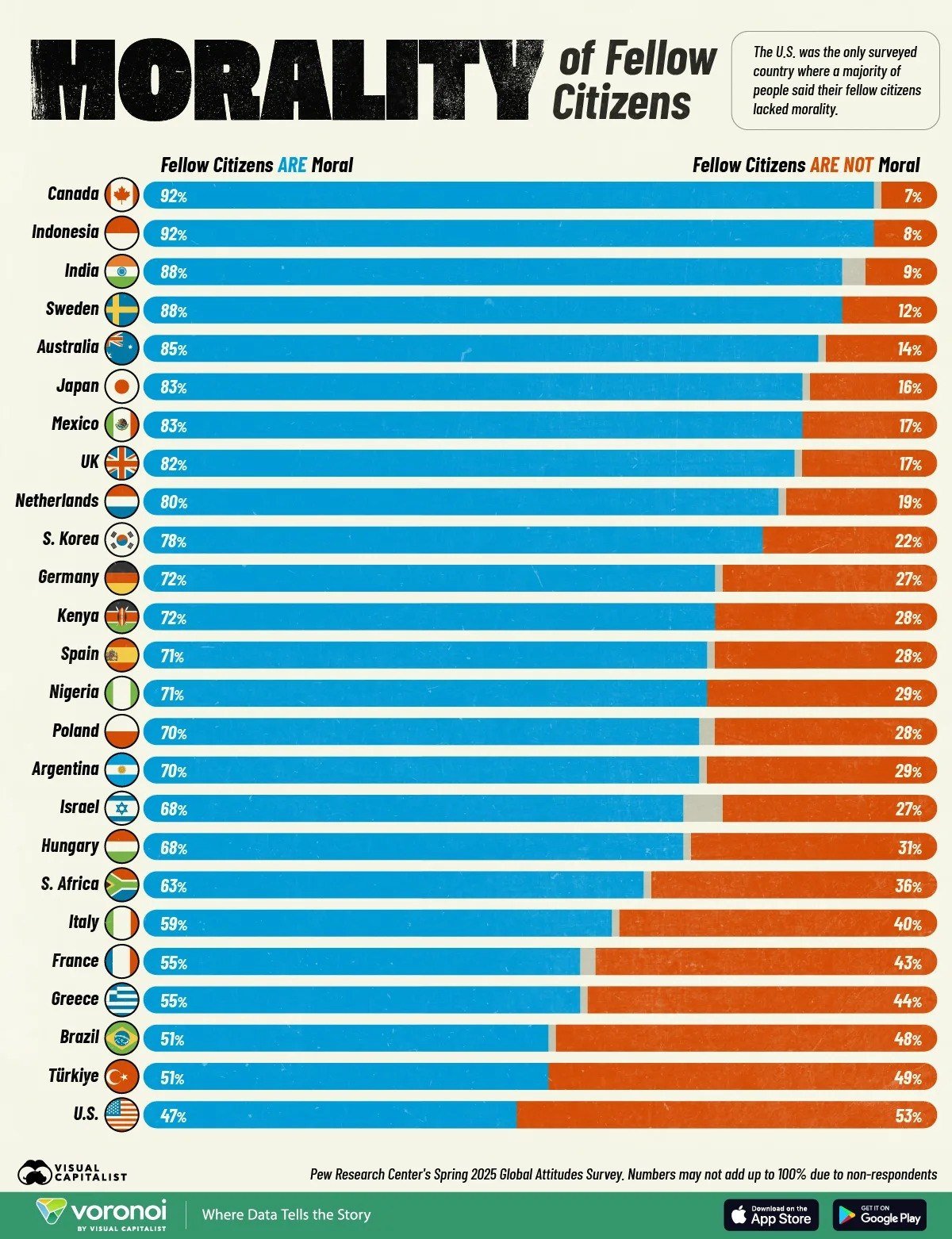
Canadians and Indonesians View Countrymen Positively

Canadians and Indonesians View Countrymen Positively Canadians and Indonesians hold the highest opinions of their compatriots, with 92% in both countries believing their fellow citizens are decent people. In contrast, the majority of Americans, at 53%, consider their compatriots to be immoral, making the US the only country in the survey with such a negative perception. Other countries with lower positive views include Turkey, Brazil, Greece, and France.
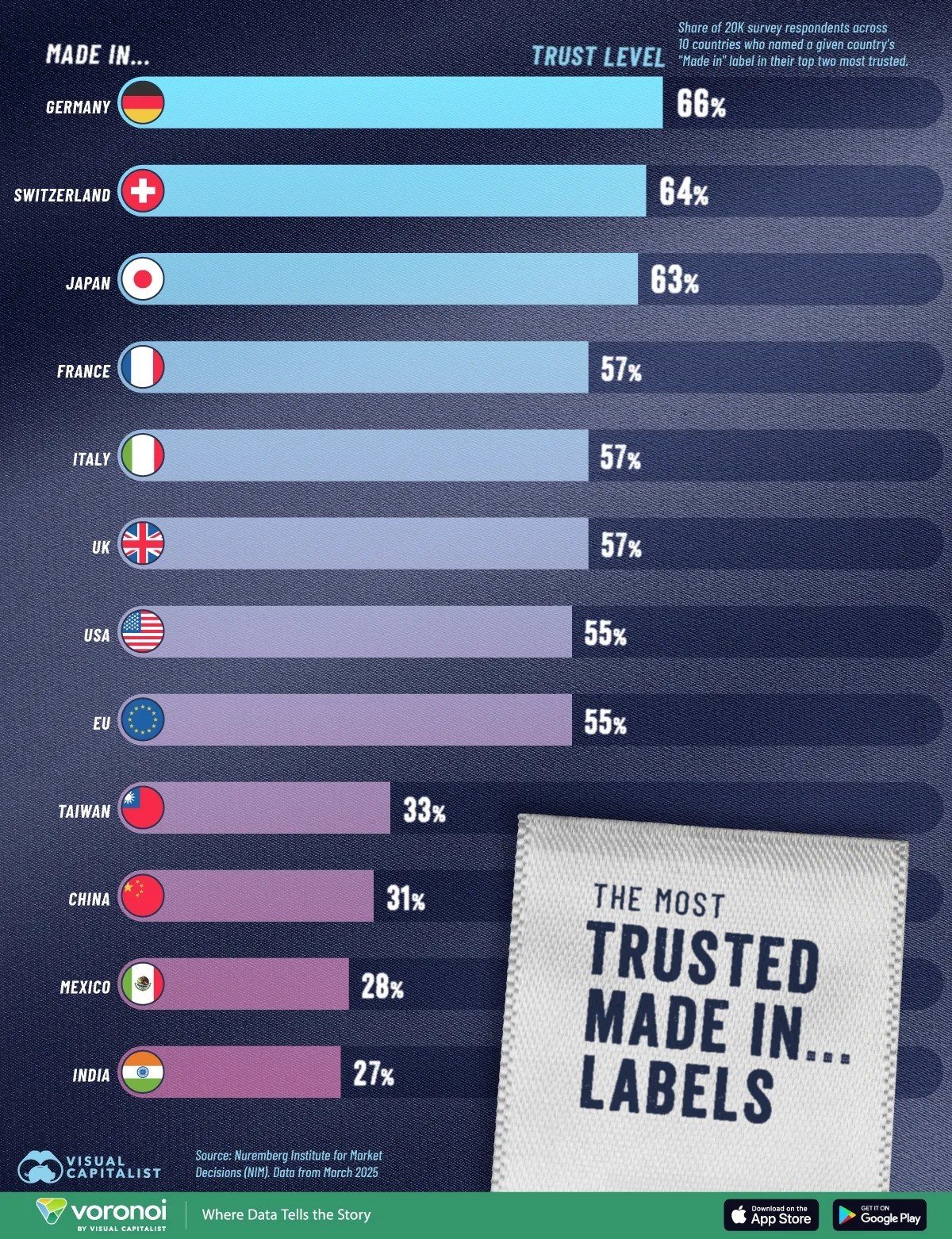
Which "Made in..." Inspires the Most Trust?

Which "Made in..." Inspires the Most Trust? According to a survey of 20,000 people across 10 countries, German products are the most trusted, with 66% of respondents expressing confidence in them. Switzerland follows closely at 64%, with Japan at 63%. On the other end of the spectrum, Indian products are the least trusted, with only 27% of respondents expressing confidence in them. Following closely behind are Mexico at 28%, China at 31%, and Taiwan at 33%.


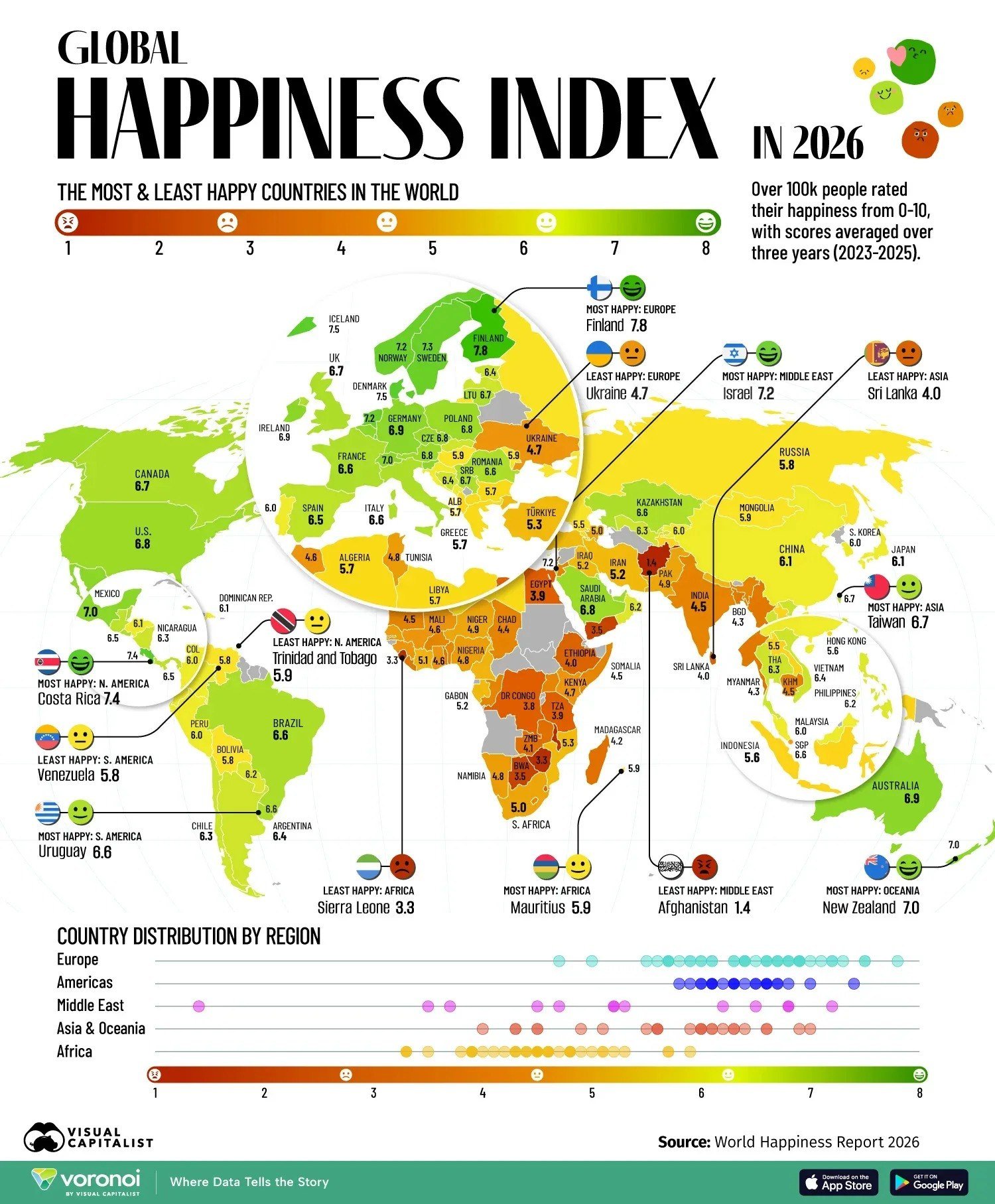
Happiness Levels Across the World

Happiness Levels Across the World The happiest people reside in Northern Europe. In Finland, the average happiness level reached 7.8 points, while in Iceland and Denmark it was 7.5 points each. Slightly lower were Costa Rica, Sweden, and Norway. With a happiness level of 5.8 points, we are situated towards the bottom of Europe. Our level is noticeably higher than Ukraine and slightly higher than Greece, Albania, and Bulgaria, but a bit lower than Hungary and Moldova. Surprisingly, it is the same as in Venezuela. The unhappiest country in the world is Afghanistan, which comes as no surprise.


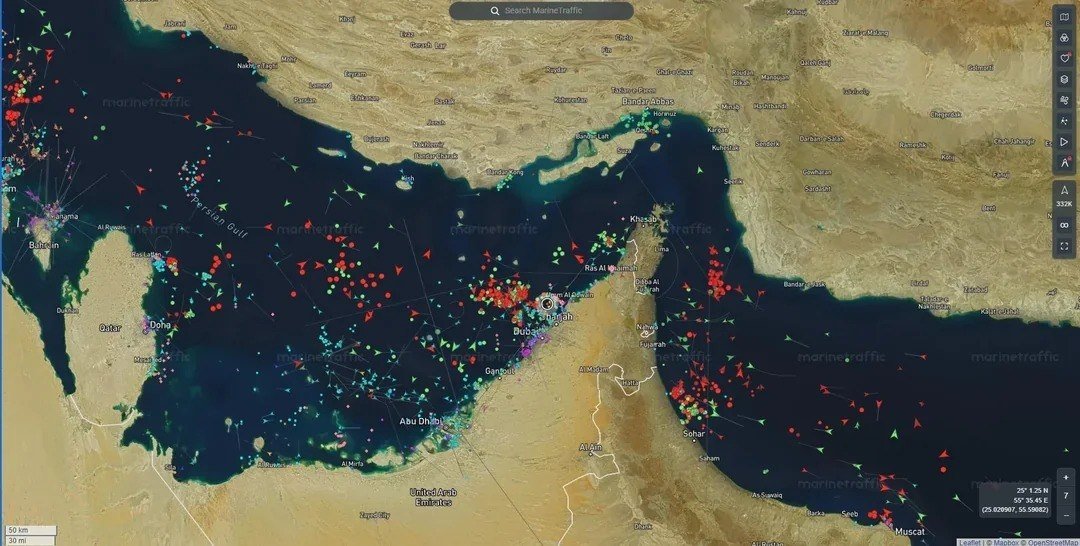
Ships in the Persian Gulf

Ships in the Persian Gulf In a recent snapshot of the area, red dots on the map indicate the presence of oil or gas tankers, while the Strait of Hormuz appears notably devoid of vessels. This visual representation highlights the concentration of shipping activity in the Persian Gulf, with a noticeable gap in traffic through the critical chokepoint of the Strait of Hormuz.


Share of International Tourism in Gulf Countries' GDP

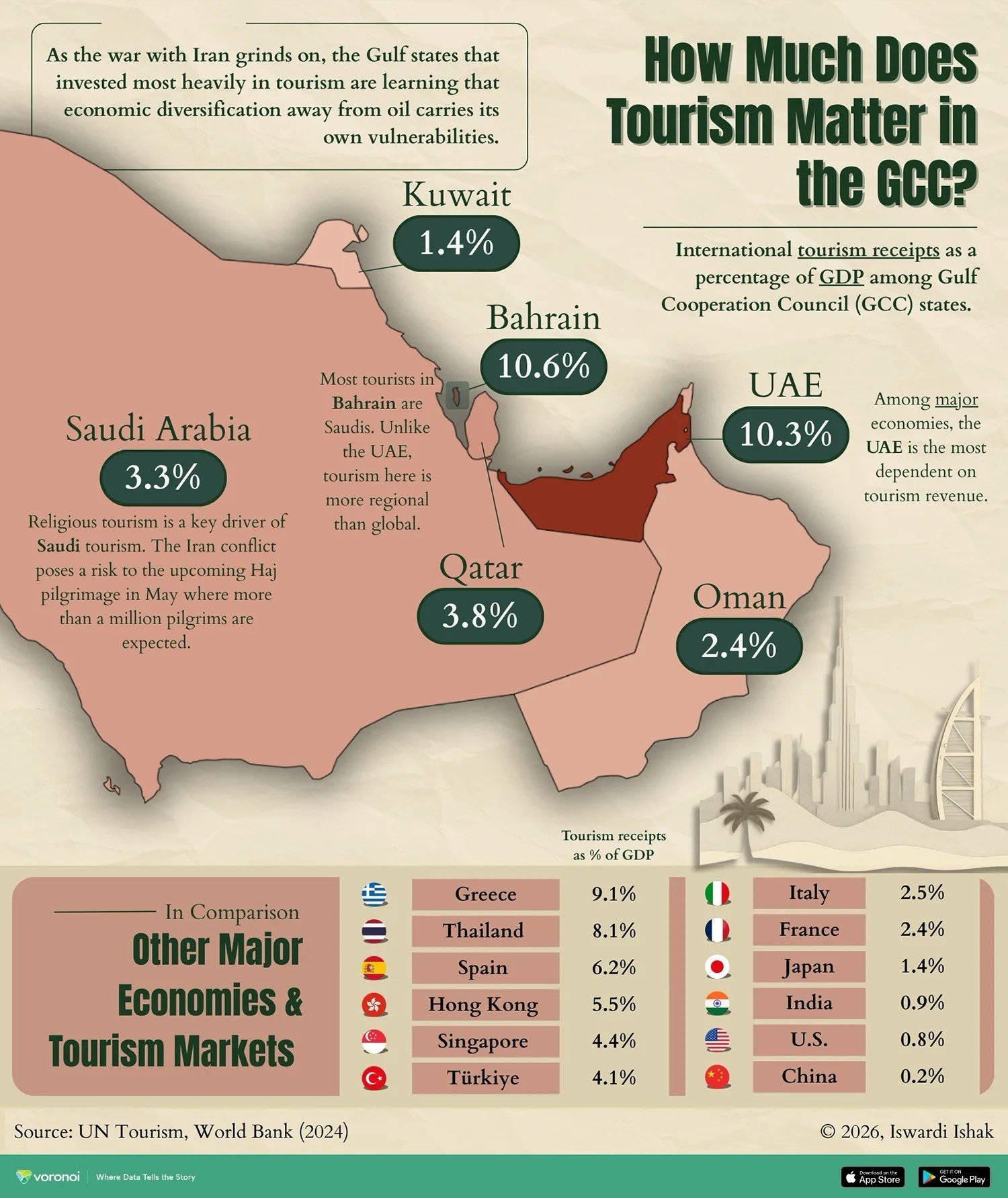
Share of International Tourism in Gulf Countries' GDP The decline in tourist flows, attributed to the conflict in Iran, is expected to have a notable impact on Bahrain and the UAE. These two countries heavily rely on tourism, with the sector contributing more than 10% to their GDP. By comparison, in leading European and Asian tourist destinations, the tourism sector accounts for between 2.5% (like in Italy) and 9.1% (such as in Greece), with no country surpassing the 10% mark. Bahrain predominantly welcomes tourists from neighboring Saudi Arabia, while the UAE enjoys a more diverse tourist base. A reduction in these tourist numbers could potentially lead to severe economic repercussions for both countries.


Iran's Position Compared to Neighbors in the Middle East

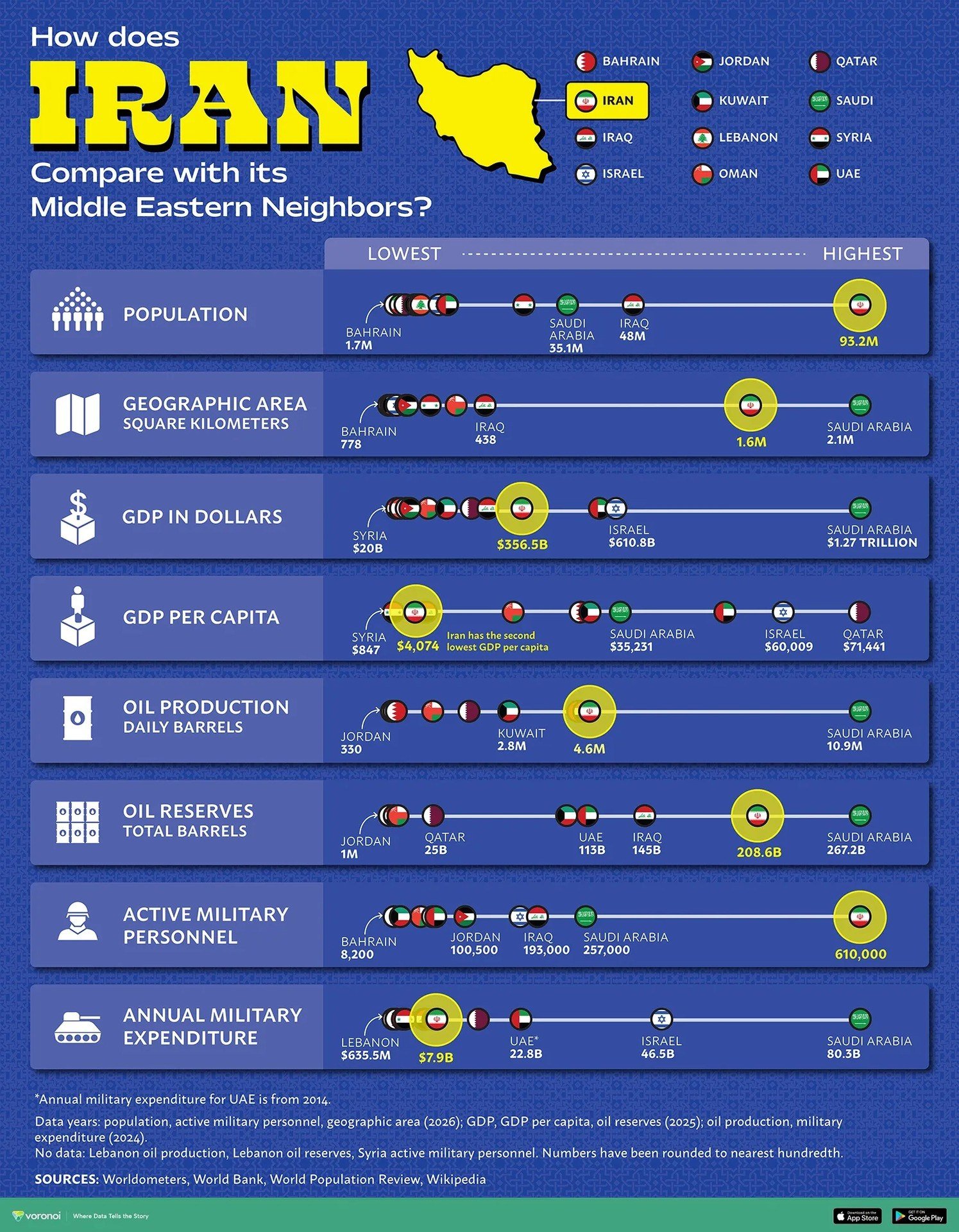
Iran's Position Compared to Neighbors in the Middle East Iran's position in the Middle East is notable when compared to its regional neighbors. In terms of population and military personnel, Iran leads by a significant margin. Additionally, it ranks second in area, oil production, and reserves, with Saudi Arabia having a larger area dominated by desert landscapes. Despite its strengths, Iran ranks second to last in GDP per capita, although it maintains a total GDP slightly below the regional average. Notably, the country falls significantly below the regional average in total military expenditures, showcasing a unique positioning in the Middle East.


Difference in the Duration of Universal Suffrage between Men and Women in European Countries

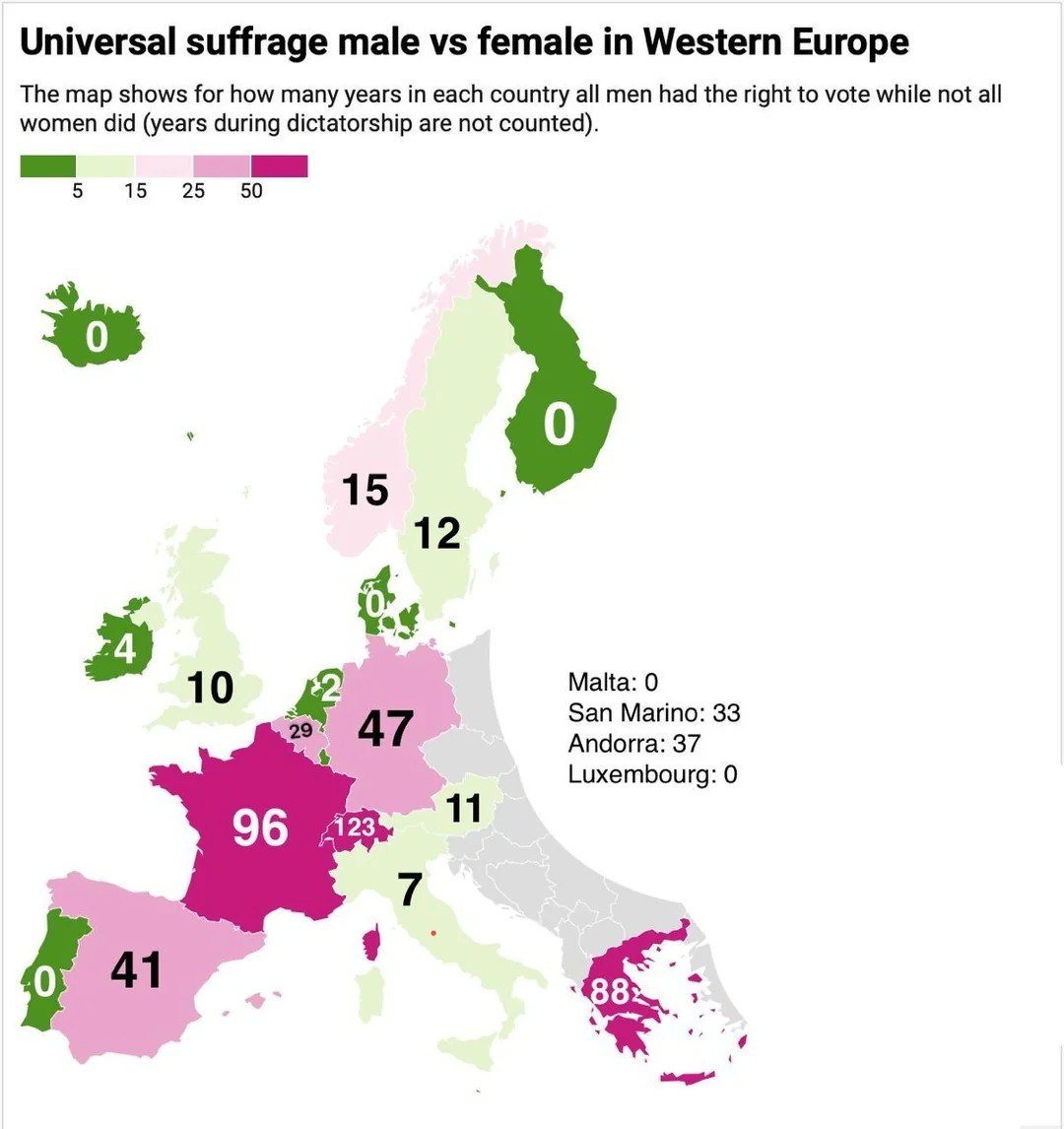
Difference in the Duration of Universal Suffrage between Men and Women in European Countries In Iceland, Finland, Denmark, Portugal, Malta, and Luxembourg, both men and women gained the right to vote simultaneously. Meanwhile, in the Netherlands, men obtained this right two years before women, and in Ireland, there was a 4-year gap. However, in Switzerland, the difference was a significant 123 years. France and Greece also lag behind in this aspect, with differences of 96 and 88 years, respectively.


What happens if warm currents in Northern Europe cease

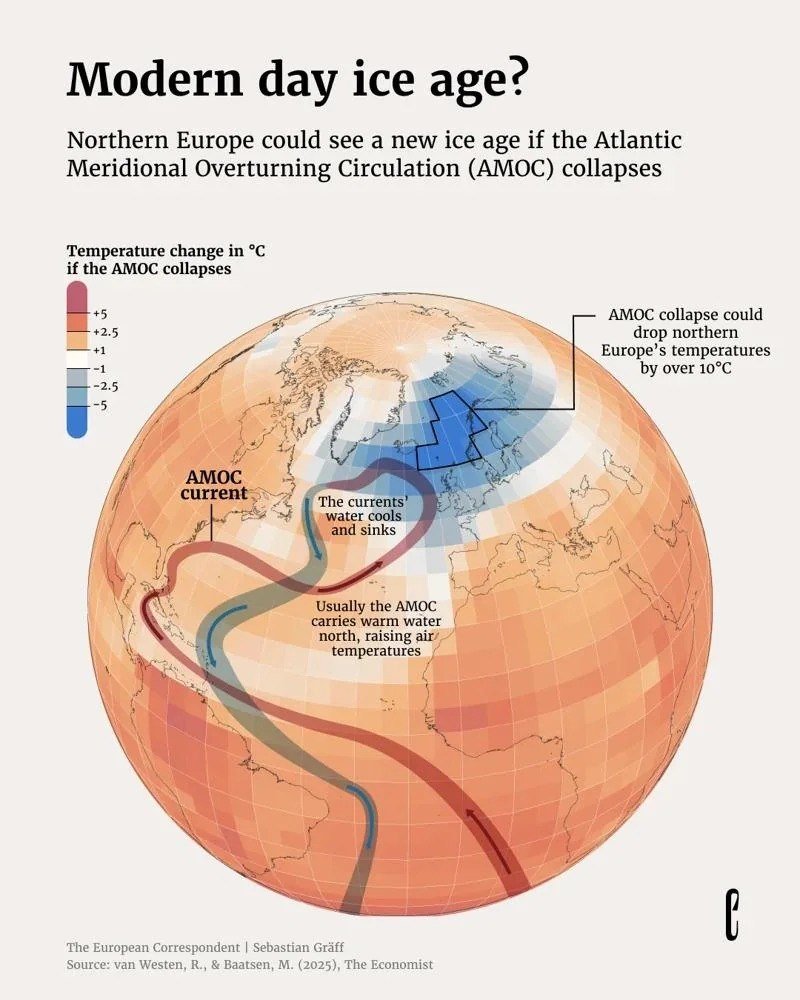
What happens if warm currents in Northern Europe cease The Atlantic meridional overturning circulation, a significant system of currents like the Gulf Stream, transports warm Atlantic water to Europe and returns cold water. If disrupted, it will lead to a significant drop in average temperatures. Projections indicate that some areas could experience temperature decreases of more than 10 degrees. The most affected regions will be Scandinavia and Iceland, with noticeable cooling extending to the British Isles, northern France, Germany, and the Baltic region.


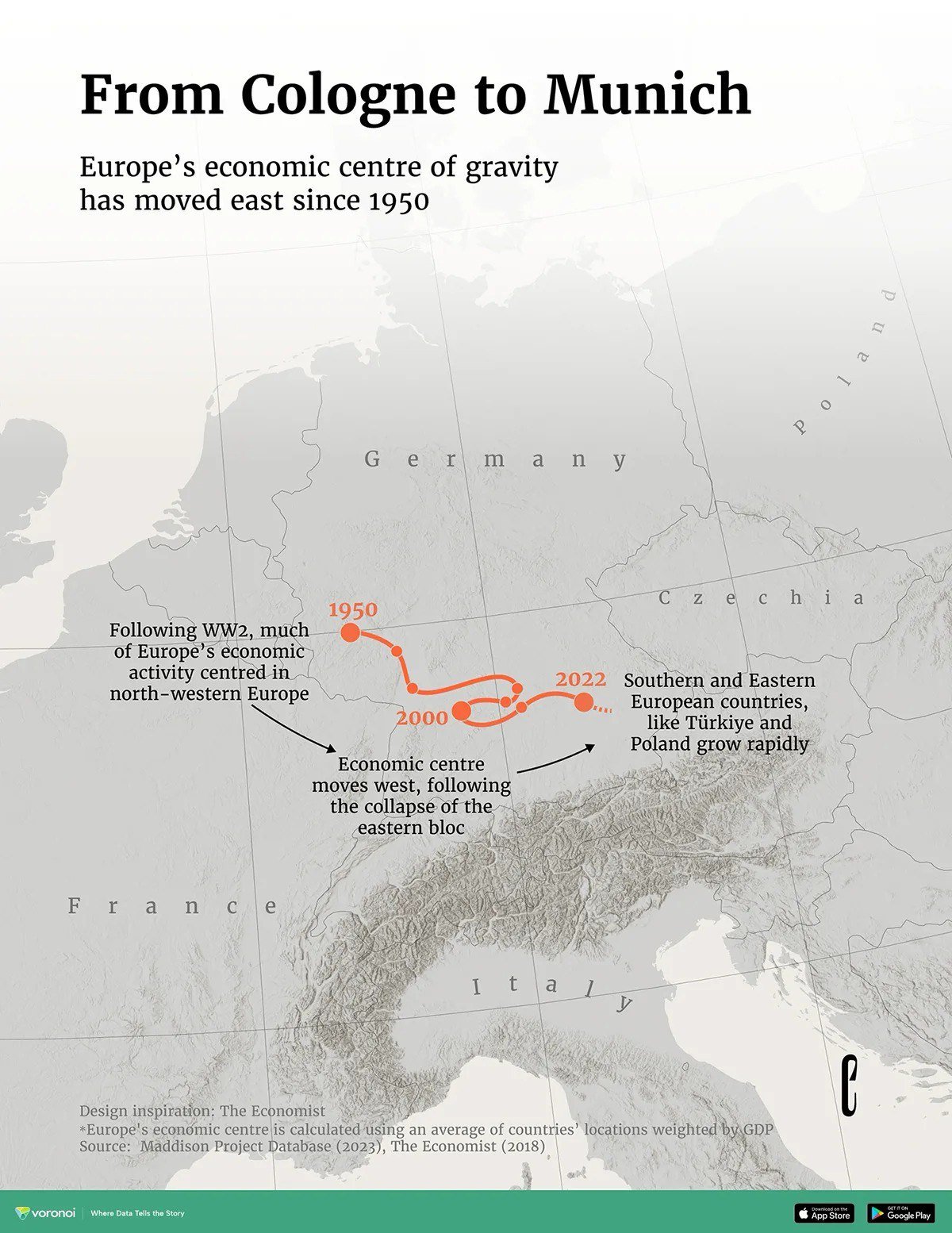
Shifting Economic Center of Europe Since 1950

Shifting Economic Center of Europe Since 1950 The economic "center of mass" of Europe has been gradually moving towards the southern part of Germany, with a notable drift southward in the latter half of the 20th century and a significant shift eastward between 2000 and 2022. During this period, there has been a relative weakening of Great Britain, contrasted by the strengthening of Eastern Europe and notably Turkey, a trend that has become more pronounced in recent decades.


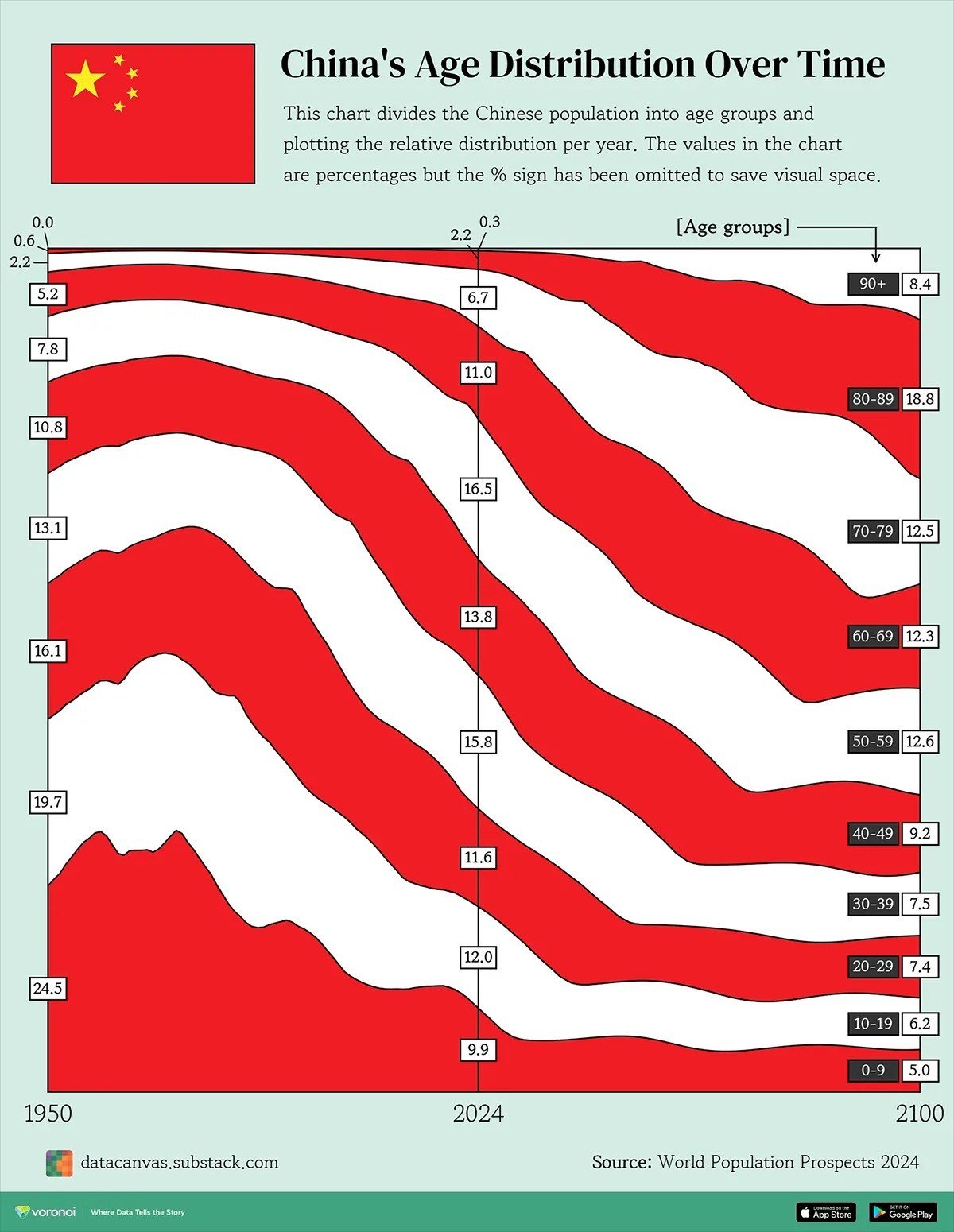
Age Structure Shift in China: Evolving Demographics Over Half a Century

Age Structure Shift in China: Evolving Demographics Over Half a Century In 1950, 0-9-year-olds were the most significant age group in China, making up 24.5% of the population. This percentage occasionally exceeded 25% during the 1950s and 1960s. Fast forward to the present day, where children under 10 now represent only 9.9% of the population. In contrast, individuals aged 50-59 have taken the lead, constituting 16.5% of the population, a substantial increase from the 7.8% recorded in 1950. Looking ahead to 2100, projections suggest that children under 10 will make up a mere 5% of the population. The most prominent demographic group in China by then is anticipated to be individuals aged 80-89, making up a significant 18.8% of the population, a stark contrast to the 2.2% currently and a mere 0.6% in 1950.